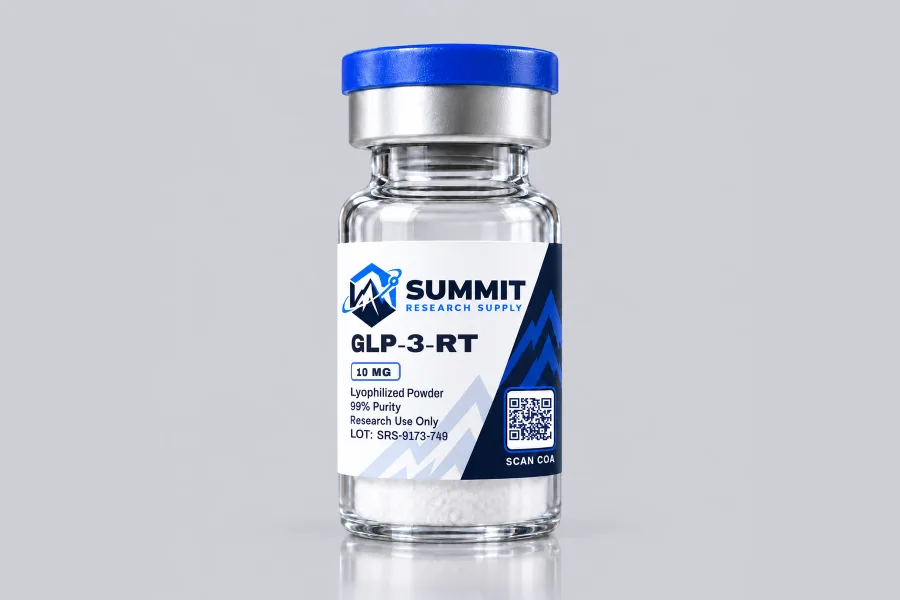
CagriSema (10 mg vial)
Once weekly subcutaneous protocol for metabolic and weight-management research.
This pairing copies the CagriSema playbook: an amylin analog and a GLP-1 agonist suppressing appetite through two independent pathways, a combination that beat either drug alone in phase 2. The protocol below doses both once weekly on the same day, each titrated on its own ladder.
Quick answer: at the standard 10 mg + 2 mL reconstitution, a 2.4 mg each dose of CagriSema draws 96 units (0.96 mL) on a U-100 insulin syringe, once weekly subcutaneous.
Protocol overview
Dosing & reconstitution
Frequency: Once weekly subcutaneous
Typical duration: 16+ weeks
Reconstitution: 10 mg vial + 2 mL bacteriostatic water = 5 mg/mL. Units below are for a U-100 insulin syringe at this concentration.
| Phase | Dose | Units per injection |
|---|---|---|
| Weeks 1-4 | 0.25 mg each | 10 units (0.1 mL) |
| Weeks 5-8 | 0.5 mg each | 20 units (0.2 mL) |
| Weeks 9-12 | 1.0 mg each | 40 units (0.4 mL) |
| Weeks 13-16 | 1.7 mg each | 68 units (0.68 mL) |
| Week 17+ | 2.4 mg each | 96 units (0.96 mL) |
Units = (dose ÷ concentration) × 100 on a U-100 syringe. Change the vial size or water volume and the calculator redoes all of this for you.
Track this protocol → Free account · log doses, rotate sites, never lose your history
CagriSema dosing schedule
REDEFINE 1 escalated both components in parallel, four weeks per step, to 2.4 mg of each by week 16. One detail worth being exact about: the two were never supplied premixed in a single solution. The trial delivered them from a dual-chamber pen that combines them immediately before injection, and no published compatibility data support combining them in one research vial — which is why the stack calculator treats them as two separate amounts.
| Phase | Amount | Frequency | Notes |
|---|---|---|---|
| Weeks 1–4 | 0.25 mg / 0.25 mg | Once weekly | Both components at the lead-in step. |
| Weeks 5–8 | 0.5 mg / 0.5 mg | Once weekly | |
| Weeks 9–12 | 1.0 mg / 1.0 mg | Once weekly | |
| Weeks 13–16 | 1.7 mg / 1.7 mg | Once weekly | |
| Week 17 onward | 2.4 mg / 2.4 mg | Once weekly | Maintenance for both components. |
Study length: 68 weeks in REDEFINE 1 — escalation through week 16, then 52 weeks of maintenance. Registry: NCT05567796.
Reconstitution and measurement
This part is arithmetic and does not depend on the evidence level. Concentration is vial size divided by the bacteriostatic water you add. Draw volume is your target amount divided by that concentration. Units are draw volume times 100, because a U-100 syringe reads 100 units per millilitre. Common vials for CagriSema: Not stocked by our featured supplier.
- Wipe the stoppers of both vials with an alcohol swab and let them dry.
- Draw the bacteriostatic water with a sterile syringe and inject it slowly down the inside wall of the peptide vial — never straight onto the powder.
- Swirl gently until the solution is clear. Do not shake; foaming and agitation damage peptides.
- Label the vial with the date and concentration, and refrigerate at 2–8 °C protected from light.
Storage and stability
Supplies math
Whatever amounts your research uses, the planning arithmetic is the same. The calculator runs all of this per compound.
Supplies by protocol length
Based on the maintenance dose above (2.4 mg each, once weekly subcutaneous) and a 10 mg vial reconstituted with 2 mL.
| Duration | Injections | Vials | Syringes | Bac water | Swabs |
|---|---|---|---|---|---|
| 8 weeks | 8 | 2 x 10 mg | 9 | 1 x 10 mL | 16 |
| 12 weeks | 12 | 3 x 10 mg | 14 | 1 x 10 mL | 24 |
| 16 weeks | 16 | 4 x 10 mg | 18 | 1 x 10 mL | 32 |
Syringe count includes ~10% spares. Swabs = 2 per injection (stopper + site). Vial count assumes the full maintenance dose for the entire duration.
Important notes
Practical considerations for consistency and safety.
- Use a new sterile insulin syringe for each injection and dispose in a proper sharps container.
- Rotate injection sites (abdomen, thighs, upper arms) systematically to reduce local irritation and avoid lipohypertrophy.
- Inject slowly and steadily; wait a few seconds before withdrawing the needle to ensure complete delivery.
- Administer on the same day each week for consistency. If a dose is missed, administer as soon as possible within a few days.
- The 10 mg vial size is standard for this compound. Reconstitute with 2 mL bacteriostatic water for a convenient concentration.
How CagriSema works
A fixed combination of an amylin analog and a GLP-1 agonist. The rationale is that the two act on separate satiety pathways, so the combination is studied for an effect neither reaches alone.
Benefits & side effects
Potential benefits
- Combined amylin + GLP-1 for enhanced weight loss
- Phase 2 results exceeded either agent alone
- Dual pathway appetite suppression
- Potential for greater metabolic improvement
Possible side effects
- Combined GI side effects from both agents
- Nausea during dose escalation
- Injection site reactions
- Slower escalation may reduce sides
This list reflects published literature and community reports. Individual responses vary. Not medical advice.
Bloodwork worth tracking
The community-standard practice is a baseline panel before starting, a recheck 8 to 12 weeks in, and another after time off. For CagriSema, the markers most worth watching:
HbA1clipid panelCMPamylase/lipase
Typical time off: Taper off over 4-8 wks
Lab panels are how a research protocol stays honest: numbers move before symptoms do. Interpretation belongs with a clinician. Not medical advice.
Lifestyle factors
None of the literature above was run on a background of poor sleep and no protein. These variables move outcomes more reliably than any compound on this site.
- Protein in the 1.6 to 2.2 g/kg range preserves lean mass through any body-composition phase.
- Resistance training 2 to 4 days per week plus 150+ minutes of weekly aerobic work reinforces whatever the protocol is doing.
- Sleep is the recovery window: 7 to 9 hours at consistent times.
- Hydration matters more than usual on compounds with GI or flushing effects: 2 to 3 liters daily.
- Track the variables that matter: weigh-ins, measurements, photos, and labs at sensible intervals.
Subcutaneous technique and practical notes
General best practice from clinical injection guidance — the same fundamentals nurses are taught, none of it specific to any compound.
Quick answers
How many syringe units is a 2.4 mg each dose of CagriSema?
At the standard reconstitution of 10 mg with 2 mL bacteriostatic water (5 mg/mL), a 2.4 mg each dose draws 96 units (0.96 mL) on a U-100 insulin syringe.
How do you reconstitute CagriSema?
Add 2 mL of bacteriostatic water to the 10 mg vial for 5 mg/mL. Inject the water slowly down the inside wall of the vial, swirl gently without shaking, and refrigerate at 2 to 8 °C after mixing.
How long does a 10 mg vial of CagriSema last?
About 4 maintenance doses of 2.4 mg each, roughly 4 weeks at once weekly subcutaneous.
Does CagriSema have human trial data?
Yes. The dosing on this page is anchored to published human research (Garvey WT et al., "Cagrilintide–Semaglutide in Adults with Overweight or Obesity", NEJM 2025 (REDEFINE 1)).
How does CagriSema work?
A fixed combination of an amylin analog and a GLP-1 agonist. The rationale is that the two act on separate satiety pathways, so the combination is studied for an effect neither reaches alone.
Sourcing CagriSema
Our featured supplier does not stock this compound, and we are not going to point you at a vendor we have not looked at. Use the COA checklist on whoever you do buy from, and check the batch number on the certificate against the vial you receive.