Peptide Evidence Tiers: What Has Actually Been Studied in Humans
Almost every peptide gets discussed with the same confident tone online, as though the evidence behind them were comparable. It is not — the gap between the most and least studied compounds on this site is enormous. This page sorts them by what has actually been published in humans, because that distinction matters more than any protocol.
The four tiers we use
Tier A — approved medicine with Phase 3 randomised controlled trials. The regimen, effect sizes and adverse-event profile are all public record. Tier B — published human randomised or Phase 2 trials, but not an approved product for that use. Tier C — humans studied only in small pilots, case reports or uncontrolled observational work. Tier D — preclinical only: animal models and in-vitro work, with no meaningful human trial data.
A compound being in Tier D does not mean it does nothing. It means nobody has demonstrated what it does in people to a standard that would survive scrutiny.
Tier A — approved, Phase 3 evidence
Semaglutide and Tirzepatide sit here for metabolic indications, both with extensive Phase 3 programmes and published regimens. Tesamorelin is approved as Egrifta for a specific indication. Bremelanotide (PT-141) is approved as Vyleesi for a specific indication.
Important framing: the approval attaches to a specific finished medicine for a specific use. Research-grade material sold as a research chemical is not that product, and the approval does not transfer to it.
Tier B — published human trials, not approved
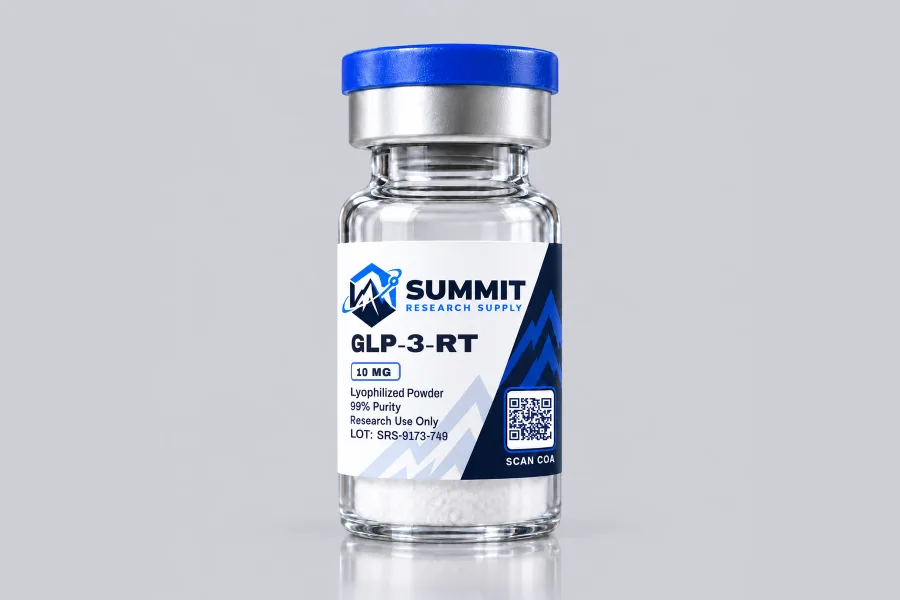
Retatrutide is the clearest example. Its Phase 2 trial was published in the New England Journal of Medicine in 2023 (Jastreboff et al.), randomising 338 adults to 1, 4, 8 or 12 mg weekly with escalation every four weeks over 48 weeks. Phase 3 work is ongoing. That is real, citable human evidence — and it is still an investigational compound, not an approved one.
Tier C — small human studies only
This is where a lot of popular compounds actually sit, and where the gap between reputation and evidence is widest. BPC-157 is the standout case. As of this review the entire published human record is three small uncontrolled reports, all from the same clinical group and the same journal: a retrospective chart review of 17 knee-pain patients given intra-articular BPC 157 (Lee and Padgett, Alternative Therapies in Health and Medicine, 2021); a 12-patient pilot in interstitial cystitis using a single 10 mg intravesical instillation (Lee, Walker and Ayadi, 2024); and a two-person intravenous safety pilot (Lee and Burgess, 2025). Roughly thirty people in total. None randomised, none placebo-controlled, and none of them using subcutaneous injection — which is the route nearly everyone discussing this compound actually means.
That matters for how the claim should be worded. Humans have been given it and something was written down, so "no human data at all" is too strong; equally, nothing in those three papers establishes a dose, so "clinically studied" is far too generous. The Phase II inflammatory-bowel-disease work the original developer ran under the code PL 14736 is referred to in that group's own review articles, but no primary report of it is indexed in PubMed — and a trial nobody can read is not evidence anyone can check.
Against that sits an unusually large preclinical literature: PubMed indexes well over two hundred records for the compound, the overwhelming majority animal work, cell work or review, many of them showing tendon and tissue-repair effects in controlled rodent injury models. The preclinical case is genuinely substantial. The human case barely exists.
Tier D — preclinical only
Several compounds discussed widely online have essentially no human trial evidence at all, resting on animal models, cell work, or small non-Western studies that have not been replicated. Where we place a compound here, it reflects an absence of published human data rather than a negative finding.
Why animal evidence does not transfer cleanly
Rodent healing models are controlled, short, and use standardised injuries — conditions that rarely resemble the messy reality being extrapolated to. Historically, translation from animal healing studies to human outcomes has been poor across many compound classes, not just peptides. A hundred rodent studies is meaningful evidence that something happens in rodents; it is weak evidence about people.
This is not a reason to dismiss preclinical work. It is a reason to describe it accurately as what it is.
What this means for reading protocols online
If a compound has no published human dosing regimen, then any protocol circulating for it was not derived from human trials. It came from animal-study conversion, from vendor marketing, or from forum consensus that hardened into apparent fact through repetition.
That is precisely why the calculators here never recommend an amount. We can tell you what 2 mg at 5 mg/mL reads as on a U-100 syringe, because that is arithmetic. We will not tell you what to use, because for most of these compounds nobody credibly can.
Where a schedule does exist in a named human trial or an approved label, we reproduce that one with its citation rather than paraphrasing it — that is what the protocol library at /protocols is for. It also shows where the citation runs out: of the sixty compounds covered there, thirty-four carry no schedule at all, because there was nothing citable to print. A protocol page that says so is doing its job.
How to check a claim yourself
Search PubMed for the compound name and look at what comes back: are the studies in humans or in rats? Are they randomised and controlled, or case reports? How many participants? Has anything been replicated independently? For registered trials, ClinicalTrials.gov shows status — and a trial being registered is not the same as a trial having reported results.
That five-minute check separates Tier A from Tier D faster than any amount of forum reading.
Key takeaways
- Evidence depth varies enormously — Semaglutide and BPC-157 are not comparably supported.
- Retatrutide has real published Phase 2 human data (NEJM 2023) but is still investigational.
- BPC-157's human record is three small uncontrolled pilots — about thirty people, no RCT, no established dose.
- If a compound has no human trial regimen, any protocol for it was not derived from one.
- Calculators here never recommend an amount; protocol pages reproduce only schedules a named human trial or approved label supports.