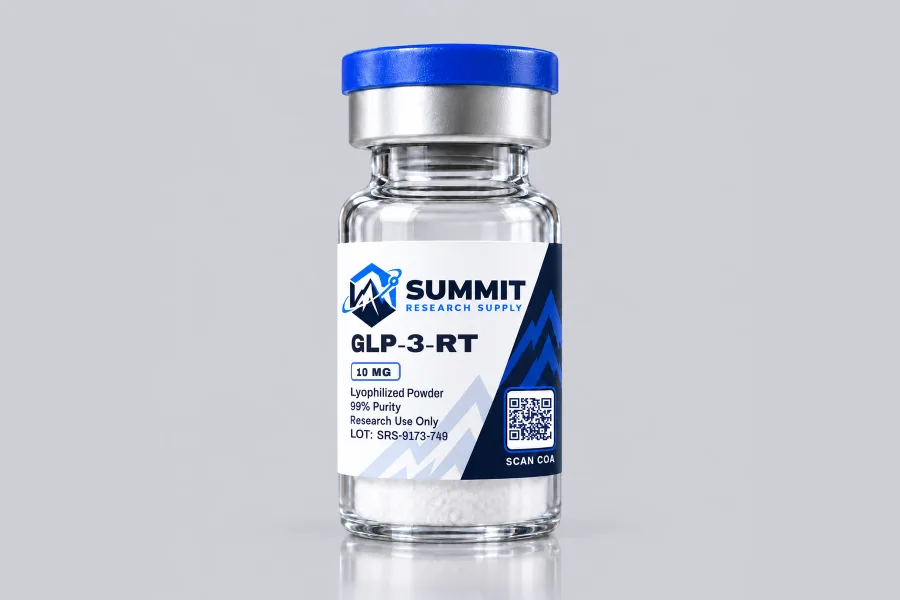
How Long Does a Peptide Vial Last? Draws, Volume and Storage
There are two separate questions hiding inside "how long does a vial last": how many draws the vial physically contains, and how long the solution stays usable once mixed. They have completely different answers, and conflating them leads to one of the most common misconceptions in peptide handling.
How many draws — the arithmetic
Divide the vial amount by your target amount. A 10 mg vial at a 2 mg target gives five draws. A 10 mg vial at a 500 mcg (0.5 mg) target gives twenty. That is the whole calculation.
Adding more water does not stretch a vial
This surprises almost everyone. A 10 mg vial at a 2 mg target gives five draws whether you reconstitute with 1 mL or 5 mL of water.
More water lowers the concentration, so each draw is a larger volume — but that larger volume carries exactly the same amount of compound. You are diluting, not multiplying. Water volume changes how a draw reads on the syringe; it never changes how much peptide the vial contains.
So why choose more water at all?
Readability. At a high concentration a small target might land on 3 units, where a half-unit misread is a large percentage error. Dilute the same vial further and that target might land on 15 units, which you can read confidently. You get the same number of draws either way — they are just easier to measure accurately.
The second question: usable window
Dry lyophilised powder is comparatively stable and keeps for a long period when stored cold and dark. Once you add water, the clock starts. A reconstituted vial should be refrigerated, kept out of light, and planned around a limited usable window — commonly discussed in weeks rather than months.
Do not freeze a reconstituted vial: freeze-thaw cycles can damage peptides. Keep the dry powder cold if you want long storage, and only reconstitute what you will get through.
Planning a vial sensibly
Work backwards. If your target amount gives twenty draws but your usable window is shorter than twenty draws' worth of time, you will discard the remainder — so a smaller vial, or reconstituting in stages if the format allows, wastes less. The calculator shows draws-per-vial alongside the unit maths so you can see both at once.
Key takeaways
- Draws per vial = vial amount ÷ target amount. Nothing else affects it.
- More water never yields more draws — it only makes each draw easier to read.
- Dry powder stores well cold and dark; the clock starts at reconstitution.
- Never freeze a reconstituted vial; plan vial size around your usable window.